In this tutorial, I’m going to learn how to store multiple data in one field. so follow this tutorial in this tutorial we have mentioned it in a very easy way.
Step 1: In Blade Page get data in a foreach().
@foreach($user_slug_summary as $index => $item)
                    <input type="hidden" value="{{ $item->slug }}" name="influencer_name[]" id="influencer_name{{ $index }}" />
                    <input type="hidden" value="{{ $item->influencer_email }}" name="influencer_email[]" id="influencer_email{{ $index }}" />
                    @endforeach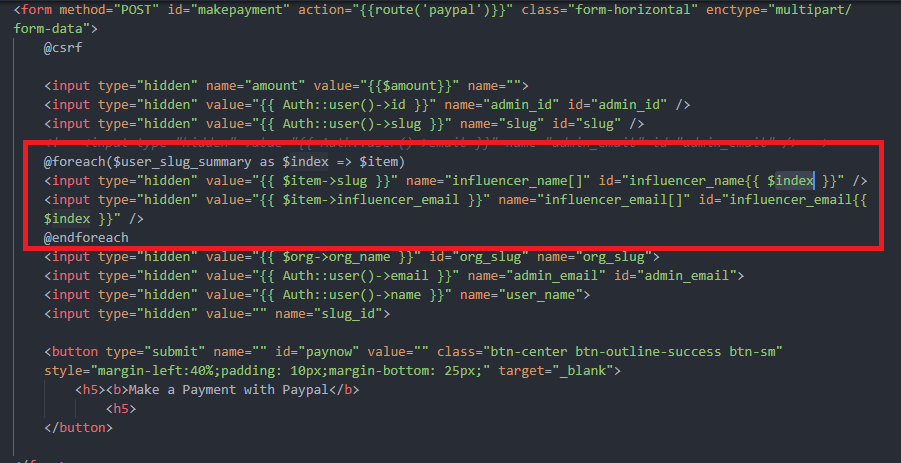
Step 2: In the Controller,
Store function:-

Log::info("success m kya aa rha h" . json_encode($request->influencer_email));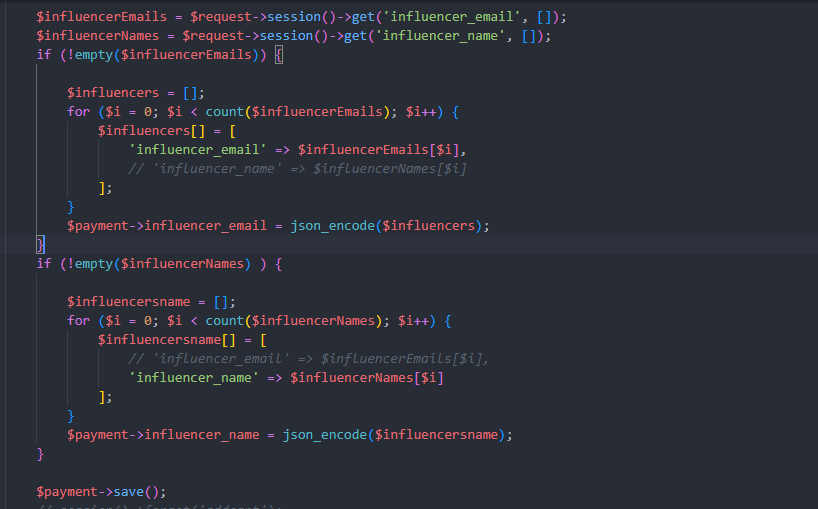
$payment = new paypal();
$influencerEmails = $request->session()->get('influencer_email', []);
                $influencerNames = $request->session()->get('influencer_name', []);
                if (!empty($influencerEmails)) {

                    $influencers = [];
                    for ($i = 0; $i < count($influencerEmails); $i++) {
                        $influencers[] = [
                            'influencer_email' => $influencerEmails[$i],
                            // 'influencer_name' => $influencerNames[$i]
                        ];
                    }
                    $payment->influencer_email = json_encode($influencers);
                }
                if (!empty($influencerNames) ) {

                    $influencersname = [];
                    for ($i = 0; $i < count($influencerNames); $i++) {
                        $influencersname[] = [
                            // 'influencer_email' => $influencerEmails[$i],
                            'influencer_name' => $influencerNames[$i]
                        ];
                    }
                    $payment->influencer_name = json_encode($influencersname);
                }

                $payment->save();
Hopefully, It will help You !!!!!!
